In 2020, I co-founded a math competition called IMTC. I continued to co-direct it until 2025. We reached over 2500 participants worldwide. I acquired sponsorships (20k+ per competition), came up with some of our problems, and helped maintain our website and write internal tools.
Selected problems
Problem 1
Given that the distinct real numbers , , and are roots of the equation
what is the value of ?
Proposed by Govind Velamoor
›Show solution
Let . Clearly , so one of is equal to zero. If , is quadratic and cannot have three distinct roots. If , then divides and must have a root with multiplicity two — forbidden by the distinctness condition. Thus .
Now . The factor of gives the root , so must be roots of . By Vieta's , so let . Substituting gives , and plugging yields , so .
The answer is .
Problem 2
Define a sequence of rational numbers so that . Find the number of possible values of so that .
Proposed by Govind Velamoor, Tanishq Pauskar
›Show solution
We work backwards. For any , either
Case 1: . The first equation gives a negative , which is impossible for since every later term is an absolute value. The second gives a positive result less than .
Case 2: . The first equation gives a positive solution greater than , the second a positive solution less than .
Case 3: . Always . And it is impossible for any other than to equal , because that would force too early.
So for : if there is exactly one valid (with ); if there are two, one satisfying and one satisfying .
We know , so and . Let and be the number of valid greater than and less than respectively, for . Then and , so — the Fibonacci recurrence in reverse.
With and , we get (10th Fibonacci) and (9th Fibonacci). So has total solutions. Recalling that can be positive or negative, we double: .
Problem 3
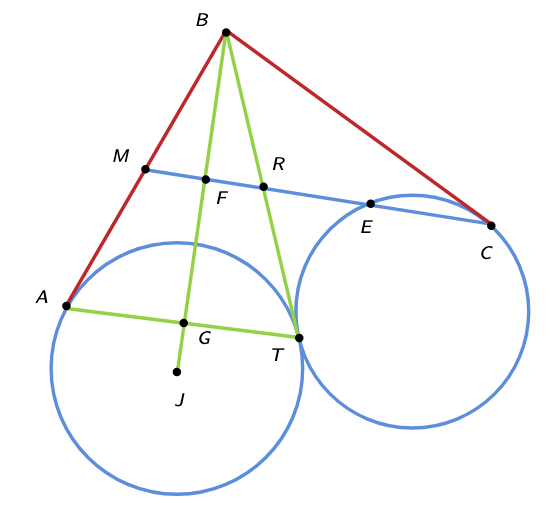
Let be an isosceles triangle with . Circles and are externally tangent at point , and are tangent to and at and respectively. The center of is equidistant from and . The median from to intersects at . Given that , find .
Proposed by Govind Velamoor
›Show solution
Let be the midpoint of . Since tangents and have equal length, the power of with respect to and is equal, so lies on the radical axis of . Call the center of the point .
Let be the degenerate circle of radius centered at , and let be the radius of . Since lies on the radical axis of , we have . But , so . The power of w.r.t. is , and w.r.t. is . These being equal, lies on the radical axis of . Since is the midpoint of its powers w.r.t. and also match, so is the radical axis of .
Construct and let it meet at . Since is the radical axis of , is the radical center of . So , making a midsegment of with .
Let the altitude from to meet at and at . Since is isosceles (equal tangents ),
Then , , and so . Power of a point at w.r.t. gives , i.e. . Finally,